STANDING FIRM PT 2– What Real Ministry Looks Like
(1 Thessalonians 2:1–16)
Introduction
The Historical, Cultural, and Religious Background of a Strategic City: Thessalonica
- The city of Thessalonica held great geopolitical importance, serving as the capital of the Roman province of Macedonia.
- Its location was highly advantageous. It was situated on the Via Egnatia, the principal road connecting Rome with the eastern part of the empire, and possessed one of the finest natural harbors in the Aegean Sea.
- Thessalonica was characterized by religious diversity. Its people worshiped Olympian gods such as Apollo and Dionysus.
- Apollo symbolized reason, order, beauty, and harmony. Dionysus represented nature, chaos, wine, and ecstasy.
- Egyptian deities such as Isis and Serapis were also worshiped.
- Isis was the goddess of magic, fertility, and motherhood. Serapis was a syncretistic Greco-Egyptian deity promoted by King Ptolemy to help unify Greek and Egyptian culture.
The Biblical Background of the Church in Thessalonica
- In 1 Thessalonians 2:1–16, the Apostle Paul presents a defense of his ministry because his opponents were slandering him in an attempt to discredit both the gospel and his character.
- Paul reflects with the believers in Thessalonica on the integrity of the gospel, his own integrity as a servant of God, and that of the fellow workers who accompanied him (Timothy and Silas/Silvanus).
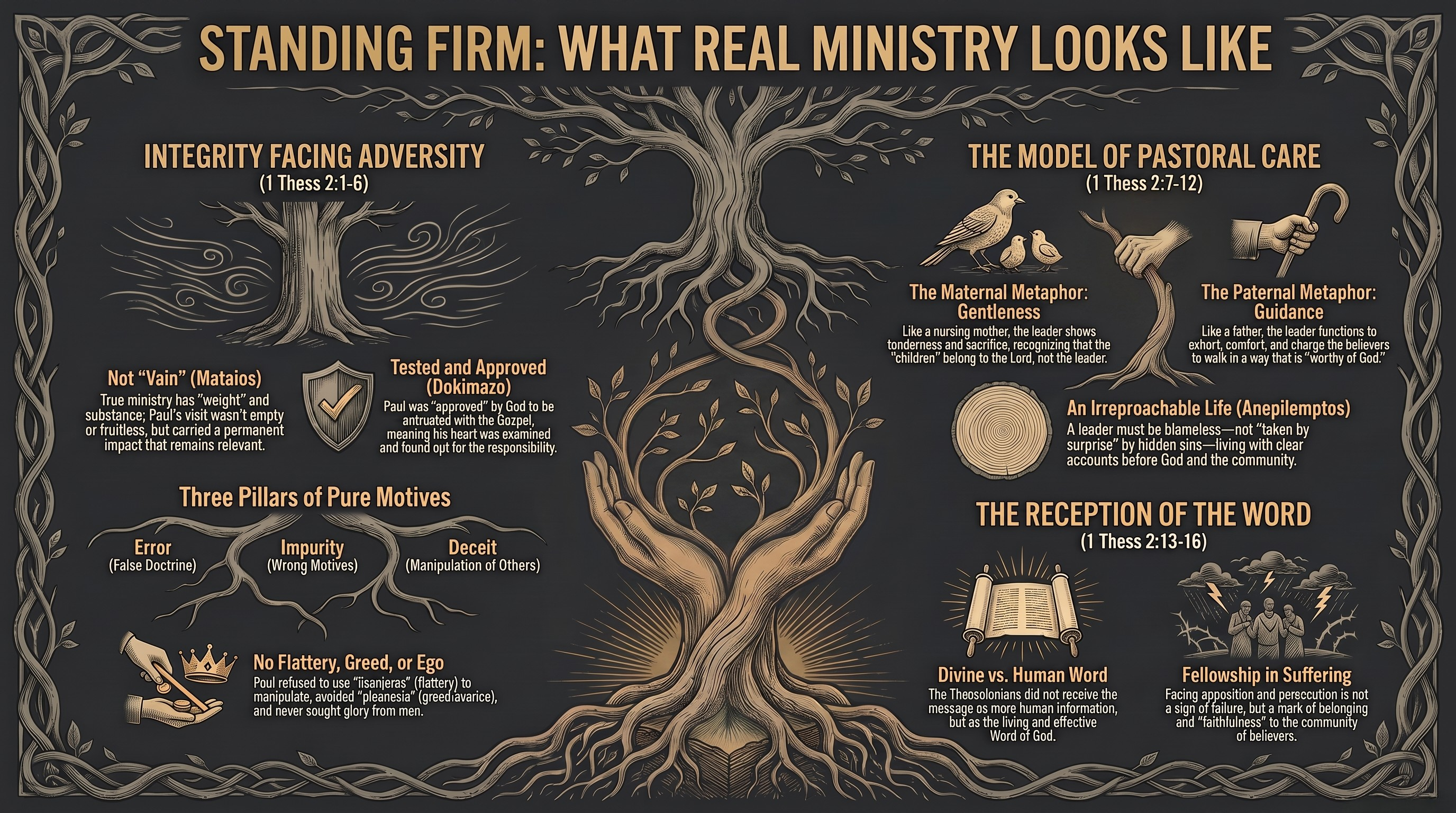
1. Integrity in the Face of Adversity (2:1–6)
Verse 1: Paul Defends the Integrity of His Ministry
- Paul tells them that his visit was not in vain.
- The Greek word for “vain” is mataios, meaning empty, useless, without value, purpose, substance, or lasting fruit.
- His ministry was not in vain because truth carries weight, substance, and produces fruit. Falsehood, however, lacks weight and substance and bears no lasting fruit.
- The term “vain” is used in the perfect tense, indicating that Paul’s ministry was not in vain in the past, is not in vain in the present, and will continue not to be in vain in the future.
Verse 2: Paul Reminds Them of His Suffering and Mistreatment in Philippi
- Paul reminds them that, as they already knew, he and his companions had suffered greatly and been shamefully treated in Philippi (Acts 16:19–24).
- They were beaten with rods (rhabdizo), meaning to strike with rods, canes, or staffs. The rod was a symbol of governmental authority.
- This legal punishment, known as virgatio, was often administered to criminals before crucifixion or used as a form of public humiliation (Matthew 27:30).
- This punishment was an injustice because it was carried out without a proper trial, despite Paul’s Roman citizenship (Acts 16:37).
- In Thessalonica, Paul and his team also faced severe opposition. They were accused of proclaiming another king, Jesus, instead of Caesar (Acts 17:1–9).
Verses 3–4: Exhortation Characterized by God’s Approval
Verse 3
Paul identifies three qualities that demonstrate the authenticity of his ministry:
- Error – His message was neither false nor deceptive doctrine.
- Impurity – His motives and lifestyle were morally pure.
- Deceit – He did not manipulate people or distort God’s Word for personal advantage.
Verse 4: Approved by God and Confirmed in His Apostleship
- Paul states that he was approved by God.
- The Greek term dokimazo carries the idea of being tested and approved.
- Tested – God examined Paul’s heart and found him fit for service.
- Approved/Entrusted – God found him trustworthy to carry both the privilege and responsibility of proclaiming the gospel.
- Therefore, Paul’s ministry was not driven by the desire to please people but to please God.
Verses 5–6: Integrity and Transparency
Paul presents three disclaimers that demonstrate the purity of his motives in apostolic and missionary ministry.
Verse 5a: No Flattering Speech
- Paul did not use flattering words (logoi kolakeias).
- This phrase refers to excessive praise or compliments intended to manipulate others or gain favor through hidden motives.
Verse 5b: No Covering for Greed
- Paul did not seek financial gain or hidden personal benefit.
- The word greed (pleonexia) refers to selfish ambition and the desire for more.
- Paul insists that he never used the gospel as a pretext for profit.
- The Thessalonians had witnessed his integrity firsthand, and Paul adds, “God is my witness.”
Verse 6: No Pride
- Paul did not seek personal glory or demand special treatment.
- His focus was to serve from a secure identity in Christ rather than seeking validation from people.
2. The Model of Pastoral Care (2:7–12)
This is the heart of the passage. Paul uses two powerful metaphors to describe the way he carried out his ministry.
The Maternal Metaphor (vv. 7–9)
Verses 7–8: Like a Mother
Paul demonstrated tenderness, affection, and sacrifice to the point that he was willing to share not only the gospel but also his own life with the Thessalonian believers.
Gentleness in Care
- Paul uses the metaphor of a nursing mother or caregiver (trophos), a woman who cares for and nourishes children.
- I believe Paul intentionally used this image because he understood that the believers under his care did not belong to him; they belonged to the Lord.
- At the same time, Paul uses the image of a nursing mother who devotes herself to meeting the needs of her child.
- Paul did not see himself as a detached worker merely doing a job. He saw himself as someone who nurtured spiritual growth with patience, affection, and genuine concern.
Verse 9: Work as Service
- Paul reminds them that he labored with great effort and hardship.
- While preaching the gospel, he worked diligently and also received financial assistance from other churches in Macedonia (Philippians 4:16).
The Paternal Metaphor (vv. 10–12)
Verse 10: The Integrity and Testimony of Spiritual Fatherhood
- Paul calls both the believers and God Himself as witnesses to his conduct, which was holy, righteous, and blameless among them.
- This is important because Christian leaders are often prime targets of Satan and the world.
A Holy Conduct
- The Thessalonian believers observed Paul’s devotion to the Lord and to His work.
- They witnessed a life separated from evil and dedicated to God.
A Righteous Conduct
- They observed a life characterized by fairness, integrity, impartiality, and kindness toward fellow believers.
A Blameless Conduct
- They saw a man who lived with the fear of the Lord and maintained a life above reproach, even though he was not perfect (1 Timothy 3:2–7; Philippians 3:12).
- This quality of being blameless is one in which all leaders must continually grow because every other qualification for an overseer is encompassed within this characteristic.
What Does It Mean to Be Blameless?
Two Greek words help us understand the biblical meaning of blamelessness.
1. Anegkletos
- A legal term meaning “not subject to accusation” or “without charges being brought against someone.”
2. Anepilemptos
- Another legal term meaning “not able to be seized” or “not caught in wrongdoing.”
A Related Synonym
- A synonym for blameless is “above reproach.”
- The idea is that there is nothing in a person’s life that others can legitimately grasp hold of in order to accuse them.
- A blameless person keeps short accounts with God and others.
- A person who is not blameless often carries unresolved issues—things left unconfessed, unaddressed, or unreconciled.
Verses 11–12: The Fatherly Function of a Pastor
- Pastors carry a responsibility of spiritual fatherhood.
- This highlights that leadership should never be authoritarian or self-serving.
- Rather, it should be nurturing through exhortation, encouragement, protection, and spiritual formation.
- The goal is to equip believers for the work of ministry and for the edification of the church (Ephesians 4:12).
- The purpose of pastoral ministry is to prepare believers through the Word and encourage them to walk in a manner worthy of God, who calls us into His kingdom and glory (Hebrews 12:28).
Walking Worthy of God
- To walk worthy of God means to live in a way that gives Him the honor He deserves.
Reflection on Verses 7–8 and 11–12
- In both metaphors, Paul emphasizes an emotional bond of mutual love.
- His sacrificial commitment to the believers reflects the teaching of the Torah that we are to love one another with practical love.
- The fulfillment of God’s commandments is expressed through love, which is the Christian’s only continuing debt (Romans 13:8).
- These verses are foundational for understanding ministerial ethics and the heart of Christian service.
- Paul uses the family analogy of a mother and a father to demonstrate how believers should care for one another within the church.
- The goal of pastoral ministry is to help believers live lives worthy of God, who has called them into His kingdom and glory.
3. The Reception of the Word (2:13–16)
Paul reflects with thanksgiving on the Thessalonians’ response to God’s Word and on the opposition they endured because of it.
Verse 13: They Received the Word of God
- Paul celebrates that they did not merely hear the Word; they received it.
- They welcomed the message of the gospel not as the word of men but as the Word of God.
- It is important to emphasize that they received the gospel not merely as information but as a living Word.
- God’s Word is alive, powerful, and effective in those who believe (John 6:63; Hebrews 4:12).
Verse 14: Fellowship in Suffering
- As the Thessalonian believers endured persecution, they became imitators of the churches in Judea.
- This reveals an even greater truth: suffering for the sake of the gospel is a sign of faithfulness and a mark of belonging to the community of believers in Christ.
Verses 15–16: Opposition Brings God’s Judgment
- Paul points out that resistance to the gospel is not merely an attack against missionaries or those who preach God’s Word.
- It is ultimately an attitude that displeases God Himself.
- Paul speaks of God’s wrath having come upon them “to the utmost.”
- In the original text, the verb can be understood as a prophetic past tense.
- Therefore, it refers to a divine judgment that was already in motion or that would inevitably come.
Conclusion
A Call to Deep Transformation for Both the Unbeliever and the Believer
- It is impossible to truly change until our guilt has been removed.
- We may change our behavior, improve our actions, and make tremendous efforts to become better people, but we cannot change what we love (Hebrews 9:14).
- Yet there is good news.
- We do not need to change before coming to Christ.
- We can come to Him dirty, broken, thirsty, and needy, and He is the One who changes us.
- We can approach Him freely because of His grace (Isaiah 1:18; Hebrews 4:16).
- Christ does not wait for us to clean ourselves up before coming to Him. He invites us to come as we are so that He can transform us from the inside out.